Sunday, 6 November 2016

A Late Christmas Present

For Christmas last year, one of our friends gave us an ‘experience’ gift, which was a trip to the Hawk Conservancy Trust near Andover. We were not able to redeem this gift until September, so a few weeks after we had come back from our holiday in Yorkshire, we set off to the vicinity of Andover.


This is a familiar route for me because I used it for a number of different reasons. One was when my No 1 son was on a sandwich year from university in 1997. He had got a placement with an American based computer company and spent a very productive year writing programmes for them. He was able to make their version of the DRDOS operating system year 2000 compliant and added other features to the kernel which boggled his course tutor when he returned to University. He had done things which demonstrated a very very deep understanding of computer systems, which I suspect from his tutor's response, was well outside his tutor’s own comfort zone. Writing changes into an operating system kernel is complex and not something even the most computer savvy people could attempt so it is something that makes me very proud of my No 1 Son.


Before that, in the 1980s I used to use this route to drive down to the IBA engineering department . The organisation that determined the broadcast standards for the ITV companies. I was able to keep up to date in my field of endeavour by attending lectures and demonstrations of new developments, such as satellite and digital TV, something they were well ahead of before Sky was launched. A European standard had been developed which was far superior to the, by then, antiquated PAL colour system and they were all set to roll out the new standard across all of the UK and Europe when the owner of Sky pre-empted everyone by launching the first Astra satellite and going ahead without official sanction using PAL broadcasts. This action allowed him to capture such a large customer base, that no one else could compete and singlehandedly he set Europe back about fifteen years technologically speaking and it was not until digital TV started that we got back on course. If he had stuck to the rules, we could have had high definition wide screen TV by 1990, but going ahead with the old technology Sky created a virtual monopoly and squeezed other services out of the market. ‘Never mind the quality, feel the width.’

Anyway, so I knew the way to Andover and off we went. The Hawk Conservancy Trust is just off the A303, a major road that eventually passes Stonehenge and in yet another era of my working life, I used to commute past there on my way to Blandford when I worked for the Royal Signals.


Long before you get that far west, the turn off for the Hawk Conservancy is down a single track lane and we arrived in good time. The day was cloudy but dry and we were able to wander around the enclosures before the flying demonstrations took place.

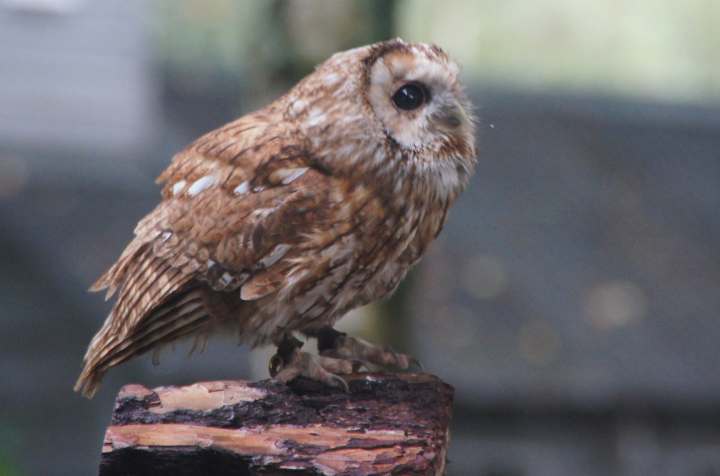
Not one of the flying display, just a local inhabitant resting on a fence
There were several venues within the large area covered by the Conservancy and several different flying demonstrations were to take place throughout the day.

One of the weekend events which we did not see since we were there n a weekday
We headed for the first one, which was the African experience. This shows a number of birds from that continent, including a Fish Eagle catching fish from the small lake, a Secretary bird killing a rubber snake, Vultures, Sacred Ibis and White Storks. They also produced a mock bush fire with hawks catching prey as the smoke drove insects up into the air.

A Fish Eagle heading in for a catch at about 90mph

Clutching his prey the eagle flies off leaving a trail of water droplets

The Secretary Bird has a really long stride


I've done my act, where's my reward?

Sacred Ibis in flight

Getting fed

Add caption

An African White Stork
African Vulture
The handlers told us that these vultures are facing extinction in Africa.  This they told us this is because of poachers.  When they kill an elephant or rhino for the ivory or horn, the vultures start to home in on the kill and a flock of circling vultures can be seen for a very long way.  This makes it obvious to the local police there are poachers in the area. Because of this, the poachers have been lacing the corpses with poison to kill off the vultures and they have been so successful, that these birds are now endangered.

Smoke is made to simulate a bush fire

This hawk is able to catch insects in a real bush fire, but here is having food thrown for it to catch
The whole event was very well run and we all agreed that we had never seen so many birds in a single flying event.

 When this was over we found our way to the next event in another arena, which again has a whole range of birds, Vultures Hawks and Eagles. There was the familiar demonstration of a hawk catching prey whirled around on a cord by the handler and a flock of vultures which were encouraged to buzz the crowd by flying low over them, making people duck.

An Eagle in flight

This hawk catches the lure

It is then allowed to eat it

A vulture buzzes the crowd


There were three of them flying over the crowd and making people duck

Resting
 The last event in this show was a whole bunch of hawks trying to catch pieces of meat which were shot into the air by catapult.


They sometimes got locked together grabbing the same piece of food, but let go before they reached the ground
The number of birds in the air at any one time was many more than I have ever seen and the whole thing was really well run.  The sky was by this time getting rather dark and as we left this arena it started to rain and we hurried into the cafĂ© for lunch. Whilst we were eating the rain went from large widespread drops to torrential and we were glad the weather had conveniently timed itself to rain at lunch time.


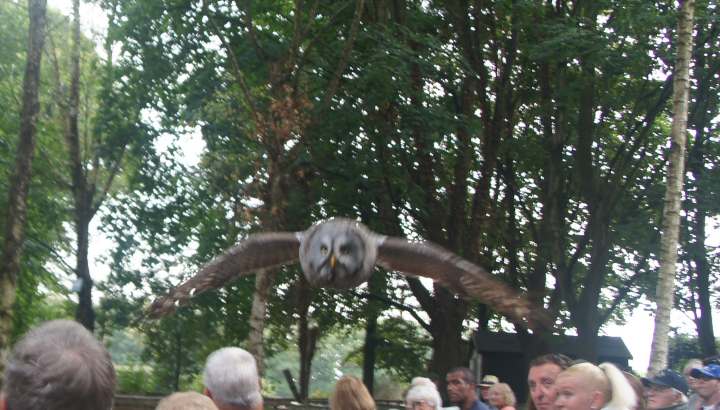
By the time we had finished lunch, the rain had stopped and we went around the parts of the Conservancy we had not seen so far. Later there was yet another flying demonstration, this time with owls and we all sat on plastic bin bags that had been handed out, to prevent getting wet from the now thoroughly wet seats. The owls performed well, but the owl’s arena was under trees and the sky was still cloudy, so the light was not sufficient to capture very good pictures of them flying.


The owls were also trained to buzz the crowd, but much more silently than the vultures

After that, we spent a while looking around the gift shop and then we went home. I also found that a Conservancy baseball cap had somehow found its way into my shopping basket, not sure how…


Altogether a great experience and I would recommend it to anyone for an enjoyable day’s outing.


Saturday, 15 October 2016

Summer Holiday - The last days

August 4 – Pickering 

The last few days seemed to rush by and for the last of them here, we simply walked around Pickering once more.


Walking down the alleyway on our way back from the shops, I suddenly saw a railway engine go past along the road. It must have been going to the NYMR rail yard to be added to their collection and by the time my camera was ready it was obvious it was on the back of a lorry and not going along by itself. This reminded me of the old movie The Titfield Thunderbolt, which I loved as a boy.


 In the movie, a couple of drunks attempt to steal a railway engine and manage to drive it off the end of the tracks and it carries on straight through the centre of the town before it crashes, much to the amazement of the local copper who cannot believe his eyes.


 If you look closely at the still from the movie, you can see the lorry wheels behind the train wheels, but in the movie it is hard to see as it rushes past.


Apart from that and a great view of the real trains in Pickering, we spent a lot of the day packing up ready to leave.

 August 5 - Leeds and Liverpool 

The next and last day, whilst the Cumbrian members of the family said their farewells and headed back to their home, we drove our two cars back across the Pennines to Liverpool Airport taking the US contingent. 

 On the way we stopped off in Leeds and visited another football stadium, this time for TS, who happens to be a Leeds fan. There we were able to take some pictures of him outside the grounds and we then went into the store to look at the merchandising that football fans desire. 


 After a browse and some purchases, we then went for lunch in Billy’s Bar, the Leeds ground restaurant.  Whilst we were there, one of the staff let us into the VIP stand and we were able to take a few pictures and look at the stadium.


Finally we returned to the hotel at the John Lennon Airport and booked in for the night. 


 We still had some time to kill, so we took a taxi to visit Liverpool One, the big shopping mall in the centre of Liverpool. After a preamble around the shops, including all the easily located sports ware and book shops, we decided to return to the hotel and started to look for a taxi rank but could not find one. On a small map we had it showed there was one near the docks, so we made our way there only to find the map was wrong. 


Still looking for the taxi rank, we came right down to the Albert Docks but had no time to explore further. What we saw suggests another trip is in order at another time.
We then made our way back into the shopping area and hailed a cab which took us back to the hotel. 


On the way I managed to snap the Anglican Cathedral, but we did not see the other one with the glass roof.

That evening we had our last meal of the holiday in the hotel and then made our way to our rooms for the night. We needed to get to bed early, because the flight was early enough to require that we arose around 5.00am in order to make quite sure we were there in time. 
Next morning, groggy and irritable we had breakfast and made our way to the airport departures lounge, only to find that the connecting flight had been cancelled. A harassed official told us that a taxi was waiting to take passengers to Manchester where they could catch another connecting flight to take them to Dublin. So after some brief farewells, they were driven off. We then headed home, negotiating the considerable roadworks between us and the M6. 

So that was the end of our holiday, but not everything finished there. The trip home for the US contingent did not go well. On arriving at Manchester they arrived too late for the connecting flight they were supposed to catch and had to reschedule. This eventually got them home several hours later than planned and so they had less time to un-jet lag before the normal routine of life began once more.

Tuesday, 4 October 2016

Summer Holiday - Day twelve


August 3 – Scarborough 


This Wednesday we took the two cars and drove off to Scarborough. As before one car went to the mobility centre whilst the other drove to the Park and Ride. Although we missed the first bus, we were able to quickly meet up in Scarborough.


It is a long time since I last went to Scarborough.  It must have been when I was around six and is so long ago that I have forgotten everything about it apart from there being a cliff tramway. I think this was the very first time I ever saw one and I remember being entranced by a train, as I thought of it, going up a steep hill. My father explained that it worked by filling and emptying water tanks under each carriage to make the heaviest one pull the other up as it went down and I have been impressed by the simplicity of the idea ever since.


Scarborough has a moderately high sloping cliff and some grand old Victorian hotels overlooking the sea from the top of the cliff.

You can get down to the beach via a whole series of paths and steps or by riding the cliff tramway.


 On the beach level were all the traditional seaside activities, from amusement arcades to donkey rides.


 Towering over the sea front is Scarborough Castle, which is a steep climb from the beach level. We did not climb up to visit the castle but walked around the harbour and the sea front until lunch time when we found a cafe and had a meal.
This sign was being unfair.  The red and yellow flags were planted in the sand and it would be very difficult to follow these instructions to the letter since swimming in sand is not at all easy.
Out at sea was the, nowadays inevitable, pirate ship giving trips around the bay

I did find the old Skylark, but it was providing fishing trips, not doing trips around the bay as of yore.


After some more ambling taking in the sights of the seaside, we returned to the town centre, some of us less enthusiastic about climbing the cliff path, via the cliff tramway.

Going up.
Along the top of the cliff, everywhere you looked on almost every tall building, there were seagull nests.  I do not recall seeing so many at any other seaside resort and they have spoiled a lot of otherwise attractive old buildings.


And talking of birds, I do like the oddball solicitor's names you find around various towns. This one was in the town centre shopping area.  In the town centre we did some shopping and then left for home. 

On the way home, we took a less direct route and went via Whitby and then across the North Yorkshire Moors.

In the wide open moorland, you can see RAF Fylingdale from a long way around.  Originally built to provide early warning of Inter Continental Ballistic Missiles (ICBMs) during the Cold War era, it continues to serve a similar purpose plus the more up to date task of tracking satellite launches.  


On the way through we stopped to admire the view and take some photos.  Where we stopped we could see the track of the NYMR railway running through a shallow valley, where you can also see Fylingdale from the train. I was hoping we might have seen a train to get some photos but we were a bit too early and would have had to wait a considerable time to catch it passing by.

Tuesday, 27 September 2016

Summer Holiday - day ten

August 2 – Pickering Castle 

Today we stayed in Pickering and walked up to the castle.


On the way up you have a view over the station and you can just make out one of the carriages in this picture.


Pickering Castle was built as a Norman stronghold during the 11th century and originally had a wooden defensive outer wall, or bailey, During the 13th century it had stone walls added.  Much of the structure still remains, although very little of it is habitable.
Unlike many English castles, it managed to remain undamaged by both English civil wars but fell into disrepair during the 16th and 17th centuries and was not maintained in any significant way until it was taken over by English Heritage in the 20th century.


Only one wall remains of the central building that was on the mound, known as the motte and originally, it would have looked much like the Great Tower at York Castle.


The bailey walls are all still standing, although often partially ruined, and so you can easily see the size of the original castle.


There are still some of the outer towers still standing but most of them are only partially accessible to the public.  The main entrance is in the base of one of the remaining towers.


One building that has been restored is the chapel and you can see some of the derelict buildings beside it.
It did not take long to explore the site and we walked around peering inside all the standing buildings and looking at the displays inside the chapel.  From the top of the mound  you could see a long way in all directions and this must have made a good lookout during the times when hostile armies may have been marching towards the castle.
After this we returned to the house for a meal.

One thing I have not so far commented on is that about the house we stayed in there were some odd ornaments.

In the landing window there was a large china cat snarling at the world which was pretty lifelike from outside.  That was kind of scary but not creepy.


However, in the kitchen there were the most creepy set of china clowns I have ever seen.


These were straight out of a Steven King novel and no one would have been surprised to find that they had moved to different positions during the night.  Imagine waking up to find one in your room.

  Aaaarrg!

Sunday, 25 September 2016

Summer holiday - Day eight and nine

July 30 – Pickering

On Saturday we did not go out but rested and walked around Pickering doing some shopping and very little else.

The old School House in Pickering

July  31 - Eden Camp

On Sunday we went to visit  Eden Camp, a World War II museum near Malton,


This is in the grounds of what was once a prisoner of war camp. At the end of the war the camp was used for storage by the MOD, but was eventually abandoned and allowed to become derelict. Much later, after a considerable amount of work clearing the grounds and restoring the original huts that had housed the prisoners, it was turned into a museum.  Each hut has a different theme and there are thirteen huts altogether. Visitors are guided around the site via path that leads you through each hut in turn. I was keen to see the museum, having been told it was very good and it turned out to be just that.
There was actually much more than you could take in on a single visit and we were somewhat overwhelmed by the sheer mass of detail.

In the building dedicated to the Dunkirk retreat across the channel, one exhibit was a rifle which had been washed up on Dunkirk beach many years after the war finished. This must have been abandoned by one of the British soldiers during the retreat.

I once worked with an older colleague called Charley Featherstone, who had actually been one of the men trapped on Dunkirk beach and he had told me of his experience. Apparently his regiment had been part of the rearguard left behind to slow the German advance and give the retreating troops time to be taken off the beach. His unit were concealed in a bunker with a hatch that allowed one man to keep watch. One morning, when it had become pretty obvious that they were going to be overwhelmed and their captain was on watch, his sergeant said to him that their newly appointed captain had not confided with him what the plan was should the Germans break through. He said he hoped their officer was not killed because he would not know what he should order the men to do. The words had hardly left his lips when a German sniper took out their captain who fell dead at their feet. The sergeant then told the men to dig a way out of the back of the bunker and all make their own way to the beach.
Charley made it to the beach but had to swim to the nearest boat and so dumped his rifle, pack, helmet and boots in order to stay afloat. He was most indignant about the whole affair, because when he re-joined his regiment back in England, he was charged for the loss of his equipment.

A lot of weapons were left behind, but this pile was recovered by the German army
Seeing the rusty rifle brought this all back to me and it occurred to me that it would be ironic if that rifle was the actual one abandoned by Charley. Of course the chances of that being the case would be millions to one against, and anyway, should it have been Charley’s rifle, there is no way I could ever know.

Some of the exhibits were a bit too realistic and in one which was simulating experiencing air raids, I felt quite disturbed presumably dragging up some distant memory of living through that time as a child. I was three when the war ended and so they must have been very deep memories, but disturbing enough to make me rather hurry to be out of that particular hut.  What surprised me was that I was affected so strongly by the simulation. You never know what is lurking in your subconscious that can jump out and bite you under the right circumstances.


I wandered around the outside the exhibits after that and found a number of interesting things to look at, including an atomic bomb, which said ‘training’ on the side and so presumably would not suddenly blow Malton off the face of the Earth if the little pin holding the detonator rusted through.


A replica of one of the feared buzz bombs was displayed outside.  These were more effective as a terror weapon than as a tactical weapon.  They only landed after the engine cut out, which was timed to happen over its target area.   The engine made a distinctive buzzing sound whilst they were flying and anyone hearing one coming and then hearing it cut out, never knew how far it would glide before hitting the ground. As a result, people would be left terrified until they heard the bang.  


As a return present, this one is one of ours and has a message for the recipient.  Unfortunately they would not have time to read the message before it arrived and so this kind of defiance went unnoticed by the Nazis.


One of the exhibits is a Soviet Russian Tank which has the motto 'Forward to Berlin' on each side in red and another on the turret, which my Russian is not good enough to translate. They certainly got to Berlin and it took a long time for the aftermath of that to return to normal.


There was also an old 1930s/40s Austin Seven which was painted the wrong colour. These cars were ten a penny post war and you could buy one for about £5 in the early 50s. They were all, without exception, black, and I recall very clearly as a child, seeing a car that was not black for the first time and being surprised. My father had at least two of these Ford models at different times during the 50s and 60s and we drove all over the country, never exceeding 40mph because that was about as much as they could manage with all of us inside.

This post seems to be becoming more of my recollections than a visit to a museum, but in this picture, there are two more things from my past.


On the right, the glass objects are accumulators, that is a  lead acid rechargeable battery, the same technology as a car battery, but just a single cell, not the six which make up a 12 volt car battery. They were used in old radios as what was called the low tension, or LT battery. These batteries give out two volts exactly and the old valve heater filaments were designed to run off this voltage in very old, allegedly portable, radios from the 1920s up to the late 1950s. I say allegedly because they were heavy. The high tension, or HT battery also needed for valves was a huge block of 80 1.5V torch batteries sealed in a branded cardboard case and provided the 120 volts the valves needed to operate. I used to play with such things as a pre-teenager and I had an ancient radio that I had been given, which needed an accumulator.  I used it to listen to radio Luxembourg, the only radio station that played rock and roll and pop music.  The BBC did not stoop so low at that time.   As well as this, my father's garage had a charging bay which always had a number of these accumulators bubbling away that his customers brought in to be charged up for their ancient radios.


The other green painted object on the left is an anti-personnel bomb and it is just like the one I found when I was a child whilst we were on holiday in Tankerton in Kent.


 Long after the war ended, the beaches around the coast were full of unexploded ordinance and in the early years post war, often parts of the beaches were fenced off with barbed wire because a UXB had been spotted but not yet cleared. We played around these and thought nothing of it, but we had been given strict instructions not to touch any bombs we found on the beach.

Whilst playing on the beach with a bunch of other boys I had met, we found a bomb just like the one in the picture. Knowing we must not touch it, and believing in a vague sort of way that it would only explode if it came into contact with human flesh, we carefully tied some string we had found around it and started to carry it off the beach. We walked up the bumpy path with the bomb swinging between us hanging on the string.  The detonator only inches from the uneven ground as we took it up to the caravan site to show our parents.
My father was already on his way down to the beach to call me in for lunch and on seeing us with the bomb, behaved much like a cat that has just seen a very large dog heading towards it with murder in mind. Crouching in a strange posture I shall always remember, he shouted very sternly, ‘PUT IT DOWN VERY CAREFULLY AND COME HERE.’ We obeyed puzzled by his behavior and having herded us safely away from the vicinity of the bomb, he phoned the police and later a bomb squad came to defuse it. We were all ticked off very sternly both by our parents and the police and asked why on earth we had picked it up when we had been told not to touch anything like it and I said in all innocence, we did not ever touch it, we used string to hold it. I really did not understand.
So lots of memories for someone as ancient as me in this museum.

Nothing really changes, just the location.  In my day it was Europe, but now it is the Middle East and children are still subject to all the horrors my generation were subjected to, Perhaps one day the human race may grow up, but it will be a long time yet I fear.

Meanwhile back in Yorkshire, having seen more than we could reasonably take in and so suffering from various degrees of data overload we gathered in the retro cafe or NAFFI, as it was called, to be in tune with the military theme and after a coffee, we returned to our house in Pickering.